
The Rise of AI Agents: From Virtual Assistants to Business Operations
Artificial Intelligence (AI) agents are rapidly evolving from simple virtual assistants into sophisticated systems that can handle complex business operations. From answering customer queries to managing workflows and making strategic recommendations, AI agents are redefining how organizations operate. Their rise marks a new era of productivity, efficiency, and innovation.
Plan
Goal‑directed reasoning & tools.
Act
APIs, RPA, and workflows.
Learn
Feedback loops & analytics.
AI agents for business: plan, execute, and learn across workflows
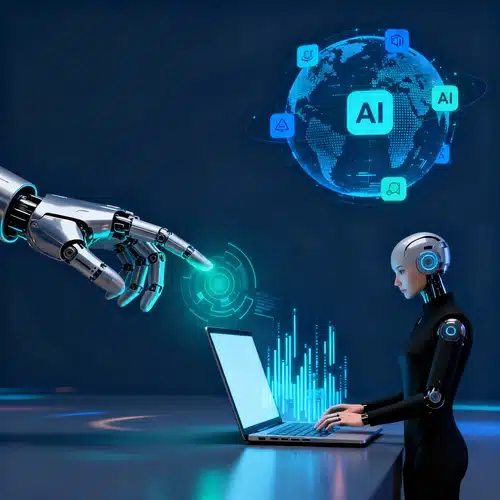
From Virtual Assistants to Intelligent Agents
The earliest AI agents appeared in the form of **virtual assistants** such as chatbots and voice-enabled helpers. These tools were primarily designed to handle routine tasks like scheduling appointments or providing basic information. While useful, their functionality was limited to pre-programmed responses.
The Power of NLP and Machine Learning
Today’s AI agents are far more advanced. Powered by **natural language processing (NLP)** and **machine learning**, they understand context, learn from interactions, and adapt to user needs. Instead of following rigid scripts, they engage in dynamic, human-like conversations and perform tasks with increasing accuracy over time.
AI Agents in Business Operations
Artificial Intelligence agents are now being integrated into **business operations**. In customer service, they manage inquiries, process orders, and escalate complex issues. In finance, they monitor transactions, flag risks, and assist with compliance. In healthcare, automated solutions provide preliminary diagnoses and patient engagement. Their versatility makes them valuable across industries.
Efficiency and Productivity Gains
One of the key benefits of Artificial Intelligence agents is **efficiency**. By handling repetitive and time-consuming tasks, they free employees to focus on higher-value activities. This boosts productivity while reducing operational costs. Furthermore, Artificial Intelligence agents can work 24/7, ensuring businesses remain responsive to customer and market needs.
The Future of Artificial Intelligence Agents
Looking forward, AI agents are expected to evolve into **autonomous decision-makers** capable of running end-to-end processes. With advancements in generative AI and multi-agent collaboration, they will play roles in strategic planning, supply chain management, and even product development. The future of business operations will increasingly depend on intelligent agents working alongside human teams.
Conclusion
In conclusion, Artificial Intelligence agents have come a long way from simple chatbots to powerful business tools. They are reshaping industries by driving efficiency, improving customer experiences, and enabling smarter decision-making. At DGS, we help companies deploy AI agents tailored to their unique needs, ensuring they stay ahead in the era of intelligent business operations.